
How our 50% buyer rebate and $6,500 minimum work
Flat Rate Realty Team · Published October 19, 2026 · Expanded guide
Our buyer rebate is calculated from buyer-agent commission received by the brokerage.
Start with commission, not the home price
Our buyer rebate is calculated from buyer-agent commission received by the brokerage. It is not 50% of the home price. The brokerage retains at least $6,500, so a smaller commission can produce a rebate below half. Before touring, buyers need lender preapproval and a signed buyer’s agent agreement. Use that conversation to confirm compensation, services, and how a possible shortfall would be handled.
Three examples of the same offer
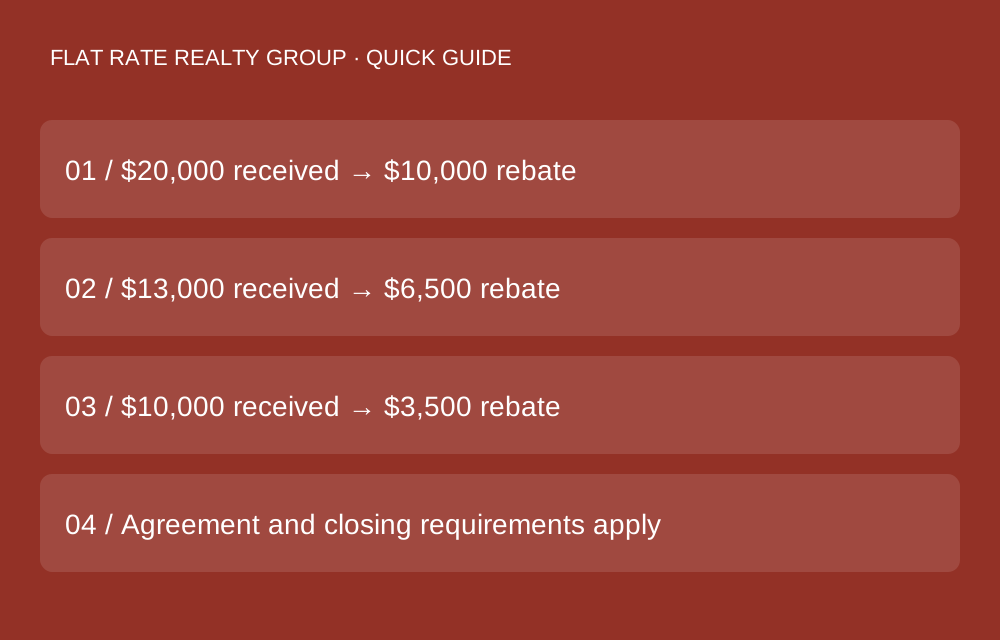
If the brokerage receives $20,000, a 50% split illustrates a $10,000 buyer rebate and $10,000 retained by the brokerage. At $13,000, both shares are $6,500. At $10,000, the illustrated rebate falls to $3,500 so the brokerage retains $6,500. These examples use commission amounts, not assumed commission rates, and do not guarantee that a seller will pay compensation.
What happens below the minimum
At $6,000 in received commission, the calculator illustrates no rebate and a $500 difference below the minimum. That calculation does not decide who owes the difference. The written agreement and transaction terms determine how any shortfall is addressed. Discuss this before making offers rather than relying on a calculator result as a final bill.
Plan the closing details early
Ask the lender and closing professional how an agreed rebate may be applied and recorded. Do not assume it will arrive as unrestricted cash after closing. Keep an agent rebate distinct from lender credits, seller concessions, and a price reduction. Review the final figures against your agreement and closing documents, and ask about any differences before signing.
Use a consistent comparison formula
For planning purposes, the illustrated rebate is the smaller of half the commission received and the commission remaining after the brokerage retains $6,500, with a floor of zero. This explains why a $12,000 commission illustrates $5,500 back rather than $6,000. At $16,000, half is $8,000 and the brokerage also retains $8,000. The calculator is a comparison tool; the written agreement and closing requirements still control the actual transaction. Enter the compensation you are evaluating, rather than assuming every property offers the same amount.
Keep your available cash separate from projected savings
A projected rebate is not money already sitting in your bank account. Make a separate list of funds needed before closing, funds needed at closing, and the reserve you want afterward. Ask how inspections, deposits, moving costs, and other expenses will be paid. Then discuss any permitted closing credit with your lender. This helps prevent a buyer from committing funds twice: once for a purchase requirement and again because a hoped-for rebate appeared to replace them.
What to discuss in the buyer agreement
Before signing, ask which services the team will provide, how compensation is determined, how seller-paid compensation is credited, and how a shortfall would be handled. Discuss the rebate calculation, the $6,500 minimum, timing, and any transaction-specific limitations. If a term is unclear, ask for an explanation before scheduling tours or submitting an offer. Keep a copy of the agreement and compare later estimates with it. The goal is a clear shared understanding of the arrangement before you commit to a property.
Questions to bring to your lender
Explain that your brokerage may provide an agreed buyer rebate and ask how it can be used in your particular financing scenario. Ask what documentation is needed, when the amount must be confirmed, and what happens if the final permitted credit differs from the estimate. Do not treat general closing-cost information as approval for your loan. Likewise, a seller concession, lender credit, and brokerage rebate are different items; ask the closing professional to show how each affects your final figures.
Choose the home before counting the benefit
A rebate should be one part of a larger homebuying comparison. A property with expensive repairs, an unsuitable layout, or ongoing costs beyond your budget may not become a good fit because of a credit. Compare Colorado homes using the purchase terms, inspection information, financing, recurring expenses, and your moving needs. Start with preapproval and the signed buyer’s agent agreement, then use the calculator to ask better questions. Confirm the final rebate when the actual compensation and closing conditions are known.
Sources and practical resources
Explore our related services and tools ↗
General planning information. Financing, credits, fees, and services depend on approval and written agreements. Military resources are independent; our brokerage is not affiliated with or endorsed by the military.